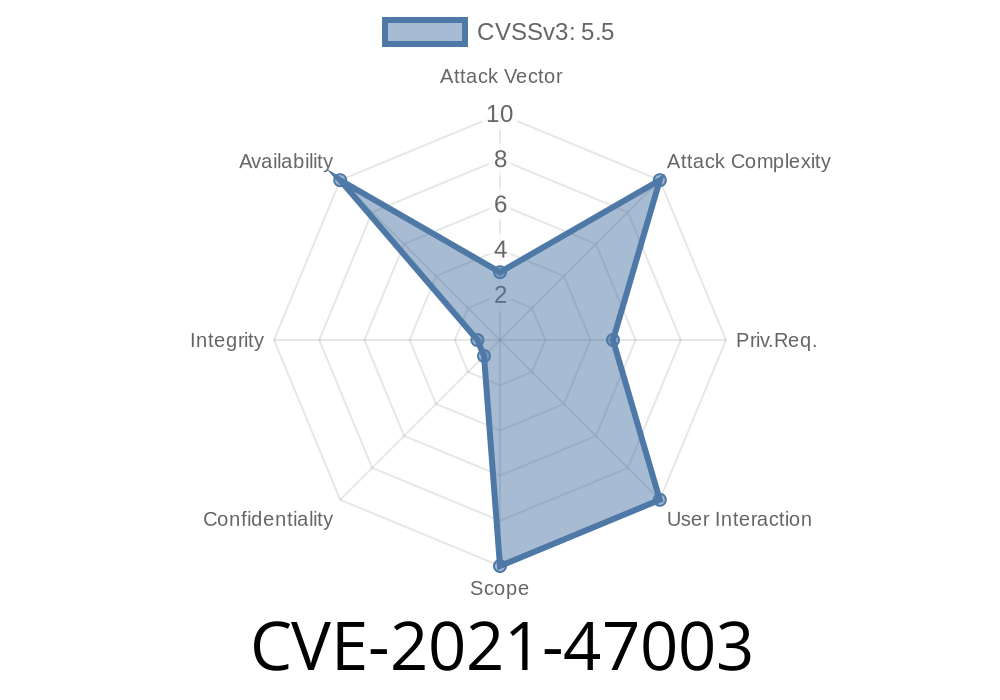
The Linux kernel is the backbone of many of the world’s computers, from servers to your favorite open-source gadgets. When a security vulnerability is found, even in obscure corners such as the DMA engine (direct memory access), it matters. One such flaw—CVE-2021-47003—was found in June 2021 in the idxd DMA engine driver.
This post will explain what happened, how to understand the risk, and how to fix or protect your systems, all in simple language. We’ll show real code so you can see how the bug worked.
What Is CVE-2021-47003?
CVE-2021-47003 refers to a vulnerability in the idxd driver within the Linux kernel's DMA engine subsystem. The problem came from mishandling a pointer in the idxd_cmd_exec function: developers occasionally passed a *null pointer* to a parameter named status, not expecting it to be dereferenced. Later, a code change added a line that dereferenced *status without checking if it’s null—which could crash the system or, in rare, complex cases, lead to more serious memory bugs.
TL;DR
- A kernel bug could crash your system if code called the DMA function without handing it a valid status pointer.
Reliability: Systems relying on the idxd driver would be less stable.
- Exploitation: While this isn’t a remote exploit, a local user or process could potentially trigger the bug and take down the machine.
The Buggy Code
Let’s take a look at what the offending code looked like before the patch. We’ll focus on the dangerous pattern involving null dereference:
int idxd_cmd_exec(struct idxd_dev *idxd, struct idxd_cmd *cmd, int *status)
{
    ...

    *status = ; // This can cause a kernel panic if status is NULL

    ...
    if (status)
        *status = some_value;
    ...
}
In some call paths, status was purposely passed as NULL, for instance, if the caller didn’t care about the result. The *status = ; would then crash the system.
Safe Code: The Fix
The kernel developers patched this quickly. The fix is simple: check if status is NULL before trying to assign anything to it.
int idxd_cmd_exec(struct idxd_dev *idxd, struct idxd_cmd *cmd, int *status)
{
    ...

    if (status)
        *status = ; // Only write if status is valid

    ...
    if (status)
        *status = some_value;
    ...
}
*You can see the fix here on Kernel.org.*
How the Bug Was Found
This kind of issue is common in C code and is called explicit null dereferencing. Coverity, a static code analyzer, flagged this bug during a routine scan:
> Addresses-Coverity: ("Explicit null dereferenced")
Other static analysis tools would also catch this, but it’s easy for a busy developer to miss such a detail during code review.
How Can It Be Exploited?
While this bug isn’t the type that’s easily abused for privilege escalation or direct code execution, it is dangerous:
- A local process with the right permissions could construct a call to the idxd driver, passing a null status.
The kernel, running with all privileges, would then crash if this happened.
In restricted environments, user-level code probably won't interact directly with this API. But flaws like these are crucial in shared or cloud environments, or where device drivers are exposed through user-level APIs.
Real-World Trigger Example (Hypothetical)
Here’s a simplified snippet of how an attacker could (hypothetically) trigger the kernel crash if they had the right permissions.
// Assume proper kernel device open and mmap done
struct idxd_cmd my_cmd;
// No intention to get status, so we pass NULL
idxd_cmd_exec(my_idxd_dev, &my_cmd, NULL); // KABOOM on buggy kernel
If you’re curious or want more context about how kernel APIs are called or these drivers are used, check the relevant Linux Documentation.
1. Update Your Kernel
If you use the idxd DMA driver (often on Intel platforms with Data Streaming Accelerator hardware), patch your kernel ASAP. The fix is merged in mainline kernels and available in many Linux distros. If you’re using Debian, Fedora, RHEL, Ubuntu, or others—check your updates.
2. Check for Exposure
Most users won’t call these low-level drivers directly. However, always audit any device drivers accessible by untrusted users or processes.
3. Practice Safe Coding in C
If you write kernel (or userland) code, always check pointers before you dereference them!
References
- Kernel Patch Fix for CVE-2021-47003
- CVE-2021-47003 entry on cve.mitre.org
- Linux Kernel DMA Engine Documentation
Conclusion
CVE-2021-47003 might seem minor, but it’s a crucial reminder: never let your kernel code write to a pointer if it could be NULL. Even small issues can have big consequences in low-level systems code.
Stay vigilant and, as always, keep your Linux systems patched and secure!
Timeline
Published on: 02/28/2024 09:15:38 UTC
Last modified on: 12/09/2024 18:25:35 UTC