In the ever-rising tide of hardware and firmware-level threats, vulnerabilities at the foundational level are among the most dangerous. CVE-2022-20826—a logic error in Cisco Secure Firewall 310 Series' Secure Boot implementation—deserves special attention. This vulnerability exposes the device to persistent compromise, allowing attackers to bypass secure boot, run unauthorized code, and defeat fundamental security assumptions.
Let’s break down what happened, how it works, and what the real dangers are.
Cisco describes this bug as follows
> “A vulnerability in the secure boot implementation of Cisco Secure Firewall 310 Series ... could allow an unauthenticated, local attacker with physical access to the device to bypass the secure boot functionality.”
- Product Affected: Cisco Secure Firewall 310 Series running Cisco ASA software or Cisco FTD software.
- CVE: CVE-2022-20826 — Cisco Advisory Link
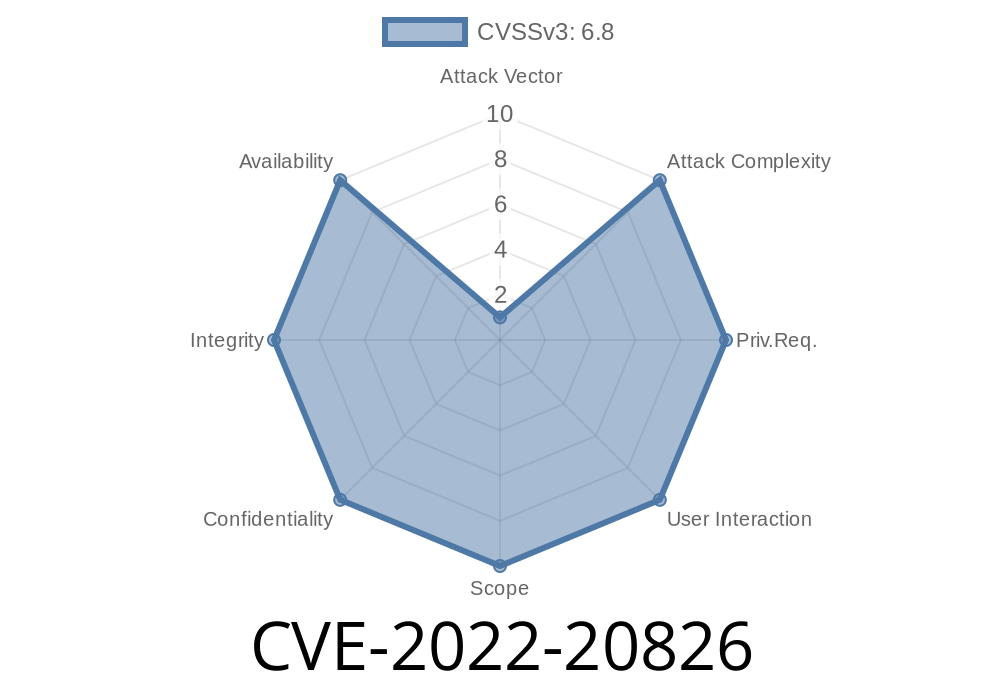
Attack Vector: Physical; requires local, hands-on access.
- Impact: Attacker can inject malicious code to run persistently during boot, completely breaking the secure boot process.
What is Secure Boot? Why Does it Matter?
Secure Boot is a security standard developed to ensure that a device boots only with legitimate software trusted by the device maker. At a high level:
Boot process starts: Hardware platform checks firmware signature.
2. Signature check passes: System continues loading authorized OS/software.
Signature check fails: Boot is halted or an alert is triggered.
If Secure Boot is bypassed, any code can be inserted at the very heart of the device’s lifecycle—before even the OS or main security software begin.
How Does the CVE-2022-20826 Vulnerability Work?
At the core, this flaw is a logic error in Cisco’s Secure Boot implementation.
Attacker injects code at a specific memory location during the device’s boot sequence.
- Due to improper validation (the logic error), the device fails to verify this memory region's contents.
- Result: Malicious code executes persistently each time the device starts, BEFORE any software-based security can activate.
Let's take a simplified look at the vulnerable process
// Pseudocode representing the logic flaw
bool verify_secure_boot() {
    // ... initial checks ...
    if (check_firmware_signature() == PASS) {
        // Vulnerability: Fails to check bootloader memory area completely
        boot_main_firmware();   // Unverified region can be hijacked
        return true;
    } else {
        return false;
    }
}
In the real bug: The code checks the firmware signature, but misses or improperly validates a memory area (such as a specific offset or payload region), allowing an attacker to inject rogue bootloader code.
Write a custom bootloader segment or payload into the unvalidated memory space.
4. Power on device; because the crucial region isn’t checked, this code runs with highest possible privileges.
Example of a Malicious Loader Snippet
; Example for illustrative purposes ONLY
; Sets up a backdoor listening service every boot
mov r, #xDEADBEEF   ; Custom port
call open_port
call await_commands
Real-World Security Implications
- Bypassing Secure Boot means malware can survive even factory resets or firmware updates, until hardware remediation.
Persistent backdoors at the hardware level are extremely hard to detect.
- Supply chain attacks become possible: rogue employee or attacker plants a bugged firewall before it’s even installed.
Affected hardware should be returned to Cisco for secure reprogramming if compromise is suspected.
- Cisco has released fixes: upgrade boot ROMs and software as directed in their advisory.
- Consider using tamper-evident physical controls or hardware security modules for critical WAN edge devices.
Secure Boot flaws are particularly severe because they undermine trust in the device itself.
- Regularly monitor vendor advisories and secure hardware physically—not just logically or on the network.
Further Reading & References
- Cisco Security Advisory — CVE-2022-20826
- NVD CVE Details
- Cisco Secure Firewall 310 Overview
- Understanding Secure Boot
_This article is written exclusively for those seeking a simplified yet deep understanding of CVE-2022-20826 and its real-life security implications._
Timeline
Published on: 11/15/2022 21:15:00 UTC
Last modified on: 11/18/2022 18:16:00 UTC