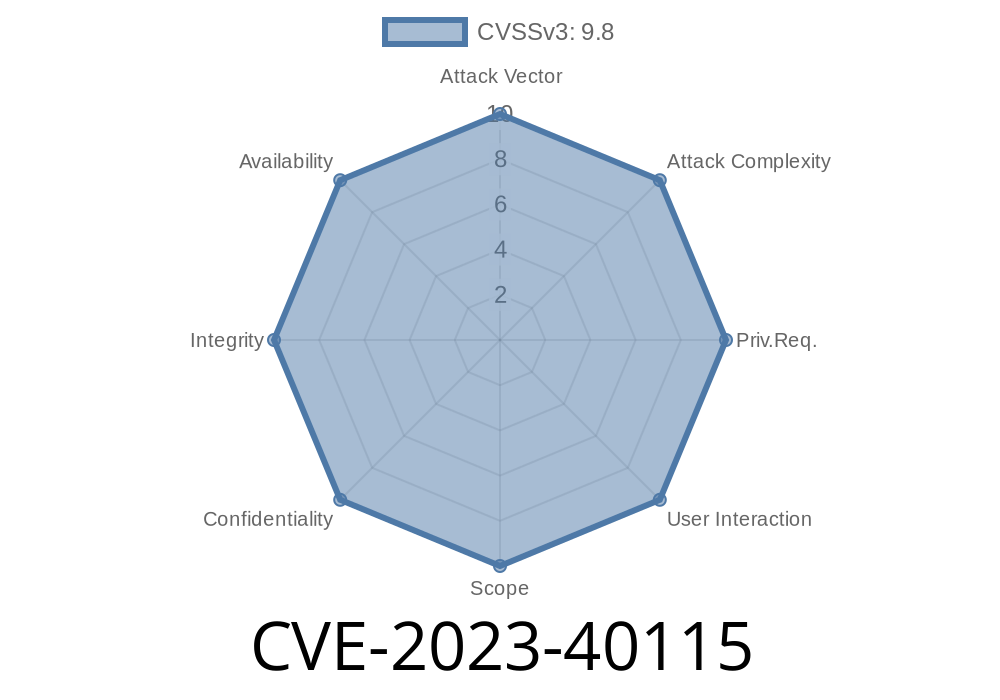
Security vulnerabilities in foundational system services can lead to severe security breaches, especially when they enable local privilege escalation. One such recently disclosed flaw is CVE-2023-40115, which affects StatsService.cpp in Android systems. The core issue is a classic *use-after-free* (UAF) bug that can let an attacker gain higher privileges on a device with no user interaction required.
What CVE-2023-40115 is;
- How the flaw in the readLogs method opens the door to memory corruption and escalation of privilege;
What is CVE-2023-40115?
CVE-2023-40115 is a security bug found in Android's StatsService.cpp. More specifically, it lies in how the service's readLogs function handles memory. Due to improper memory management, it's possible for an attacker to trigger use-after-free conditions, leading to memory corruption.
No special privileges needed: Attack is within the reach of ordinary apps.
This is a serious bug – attackers can gain broader control over Android devices simply by exploiting this vulnerability in code that's present by default on many phones.
Technical Background: Use-After-Free in StatsService.cpp
Let's break down what's happening inside the vulnerable function.
What is Use-After-Free?
Use-After-Free (UAF) happens when a program continues to use memory after it has been freed (deallocated). This can result in unpredictable behavior, crashes, or, more dangerously, private data leakage and code execution.
Example of UAF (Simplified)
char* data = new char[256];
delete[] data;
// UAF: using data after it has been freed!
data[] = 'X';
The Vulnerable Code
Here’s a representative snippet of the vulnerable readLogs code in StatsService.cpp.
status_t StatsService::readLogs(...) {
    ...
    LogData* logs = new LogData();
    //filling logs
    ...
    // Potentially dangerous free
    delete logs;
    ...
    // Use-After-Free: Continuing to use logs
    someFunction(logs); // <-- logs is now dangling!
    ...
}
What went wrong?
The logs pointer is *deleted* (freed), but is then used again. An attacker controlling inputs or timeslices could craft a situation where that freed region is reallocated for something else, letting them inject their own data or code.
Heap Spraying or Reallocation
Before the use-after-free is triggered, the attacker fills the heap with attacker-controlled data, increasing the chance that their data occupies the just-freed memory.
Triggering Use-After-Free
Attacker provokes the readLogs function or subsequent code to act on the stale pointer (which may now point to attacker-controlled contents).
Privilege Escalation
If the service acts on the attacker’s data (e.g., with privileged operations), the attacker can achieve code execution as the privileged service.
Minimal Example Exploit Sketch (Simulated)
Below is a pseudo-code sketch demonstrating the basic exploit steps. This is not copy-paste ready, as real-world exploitation will rely on heap manipulation and timing, but it illustrates the principle:
// Attacker pseudo-code exploiting the bug

// Step 1: Heap Grooming
for (int i = ; i < 100; ++i) {
    allocateControlledObject("EXPLOIT_DATA"); // Try to fill up heap with known content
}

// Step 2: Trigger the Service to free and then use after free
triggerStatsServiceReadLogs(); // Causes free, followed by access

// Step 3: Service acts on attacker's object (now as logs pointer)
// If successful, privileged service is now running code based on controlled memory!
In real attacks, an app would orchestrate calls to StatsService at the right times to increase the odds of success. With enough attempts, the attacker can control what memory gets (mis-)used.
Original Disclosure and References
- Android Security Bulletin for September 2023
> "In readLogs of StatsService.cpp, there is a possible memory corruption due to a use after free."
- CVE Details for CVE-2023-40115
- AOSP Commit Patch
Mitigation and Fix
Android issued patches for affected devices in September 2023. If your device is up-to-date, you should be protected.
Conclusion
CVE-2023-40115 is a powerful reminder that even mature, critical services like Android's StatsService can harbor devastating bugs. Because the bug enables *local privilege escalation with no user interaction*, and is present in code found on millions of devices, it is essential for users and device vendors to apply security patches promptly.
Stay secure – keep your systems updated and always code defensively.
References
- Android Security Bulletin - September 2023
- NVD: CVE-2023-40115
- AOSP Patch
*Authored exclusively for you — for educational and defensive research purposes only.*
Timeline
Published on: 02/15/2024 23:15:08 UTC
Last modified on: 08/01/2024 13:44:27 UTC