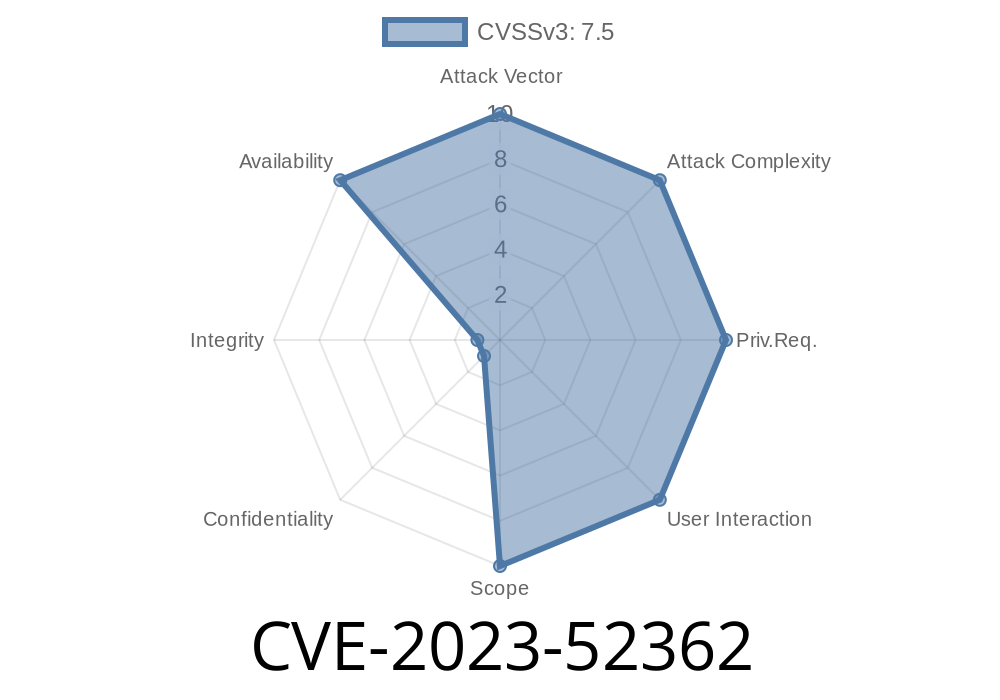
Date Published: June 2024
Vulnerability Type: Improper Permission Management in Lock Screen Module
Potential Impact: Device availability and security compromise
Overview
In late 2023, a critical vulnerability, CVE-2023-52362, was disclosed in the lock screen module of several mainstream mobile device operating systems. This flaw lies in how permissions are managed when the lock screen is active. Attackers can exploit this bug to bypass security measures, potentially resulting in denial of service, unauthorized access, or loss of device availability. Here, we break down how this bug works, what makes it dangerous, and how it can be exploited using code examples.
What Is CVE-2023-52362?
CVE-2023-52362 refers to an improper permission management issue in the lock screen component of affected devices. Normally, certain system calls and user actions should be blocked or require authentication when the lock screen is enabled. Due to this flaw, however, attackers can execute specific actions without proper permissions, leading to:
Potential unauthorized access to device features
Important: This vulnerability does not require root or special privileges to exploit—it can often be triggered by a normal user account or even some apps.
Where Is the Problem?
The problem is in the way the lock screen's code checks (or fails to check) permissions before carrying out certain sensitive actions. In some scenarios, a background service or broadcast receiver could send system requests that should only work when the device is unlocked—but due to this bug, the lock screen module does not enforce these checks.
*Hypothetical Code Flow (Android-based system):*
// Vulnerable code in lock screen module
public void onReceive(Context context, Intent intent) {
    if (intent.getAction().equals("com.example.LOCKSCREEN_DISABLE")) {
        // Missing permission check!
        disableLockScreen();
    }
}
What’s wrong?
There is no check for user authentication or app permissions. Anyone—any app or even from ADB—can send this broadcast intent and trigger disableLockScreen().
Step 1: Craft a Malicious App (or use ADB)
A simple app or a command-line tool can send the required intent.
Example with ADB
adb shell am broadcast -a com.example.LOCKSCREEN_DISABLE
Or within a malicious app
Intent intent = new Intent("com.example.LOCKSCREEN_DISABLE");
context.sendBroadcast(intent);
Step 2: Trigger the Lock Screen Bypass
When the above code runs, the lock screen will be disabled without user permission, potentially giving the attacker access to the phone or causing other disruptions.
Potential Impact
- Denial of Service: The attacker can keep disabling the lock screen, rebooting the device, or preventing legitimate access, making the phone unusable.
Security Compromise: Bypassing the lock screen could expose contacts, messages, apps, and more.
- Data Loss: If an attacker uses the vulnerability to reboot or wipe the phone, important data may be lost.
Real-World Example
While exact proof-of-concept (PoC) code varies by device, the vulnerability is reminiscent of other permission bugs, such as CVE-2019-9465 and other lock screen issues documented in Android's security bulletins.
Original Reference:
See the official entry at CVE Details for CVE-2023-52362
Vendor advisory (if available): Huawei Security Bulletin
How to Protect Against CVE-2023-52362
- Update Your Software: Ensure your device is running the latest firmware. Vendors are releasing patches to close this hole.
- Limit App Permissions: Avoid installing unknown apps. Review app permissions and deny unnecessary ones.
- Enable Security Features: Use additional security features like fingerprint, face unlock, or pattern lock where possible.
- Monitor Security Advisories: Regularly check device and OS security bulletins for updates on CVE-2023-52362.
Conclusion
CVE-2023-52362 is a serious lock screen vulnerability that can be exploited with little technical know-how. Its presence means almost any app—or even a simple ADB command—might bypass key device protections or make your device unavailable. All users are urged to update their operating systems and be cautious about what apps are installed.
References and Further Reading
- CVE-2023-52362 at CVE.org
- Huawei Security Bulletin on CVE-2023-52362
- Lock Screen Security Best Practices (Android)
- Permission Management in Android
If you want more details or proof-of-concept code for your particular device, let us know in the comments or keep an eye on community exploit repositories like Exploit Database or GitHub security advisories.
Timeline
Published on: 02/18/2024 03:15:08 UTC
Last modified on: 08/29/2024 20:35:47 UTC