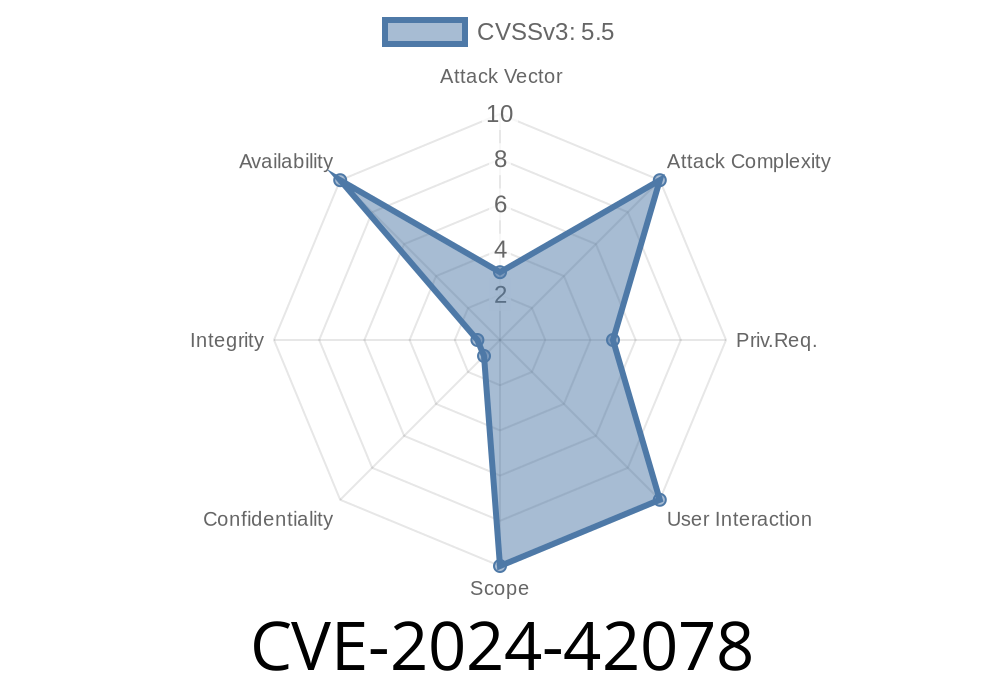
When it comes to secure and stable servers, the Linux kernel is often revered for its robustness. But even the best code can have slip-ups. CVE-2024-42078 is one such newly patched issue, focusing specifically on how the kernel's NFS (Network File System) daemon manages synchronization. This bug could have let attackers or even honest users accidentally crash your server's NFS service with a simple race condition. In this post, we break down CVE-2024-42078, show you how the exploit could work, and — most importantly — how to stay safe.
What Is CVE-2024-42078?
CVE-2024-42078 targets the Linux Kernel's NFS daemon (nfsd). Specifically, it's a bug where nfsd_info.mutex, a locking mechanism supposed to keep things safe when multiple processes touch the same data, is *not* initialized early enough.
- Component affected: fs/nfsd/netns.c (related to network namespaces in NFS daemon)
- Problem: nfsd_info.mutex can be accessed immediately after a new network namespace gets created, before the mutex is actually initialized.
- Impact: If code like svc_pool_stats_start() tries to use this uninitialized mutex, the kernel can oops (crash), with a likely denial of service.
Here’s a simplified version of what the original broken logic looked like
// Vulnerable order: mutex is initialized too late!
static int nfsd_netns_create(struct net *net) {
    // ... some code
    // Danger: mutex is NOT yet initialized!
    // but svc_pool_stats_start() might already try to use it
    mutex_init(&nn->nfsd_info.mutex);  // Should be done earlier!
}
Why Is This Bad?
In Linux, mutexes are used to make sure only one process can do something with a chunk of data at a time. Using an uninitialized mutex is like using a lock that hasn't been properly put in place — it can fail unpredictably, and in the kernel, failures usually mean panics or full-on crashes.
If an attacker or an authenticated user can trigger svc_pool_stats_start() at just the right moment, the system could crash, forcing a reboot. If you run any kind of NFS file server on your system, especially with network namespaces or containers, you could be affected.
The Fix (Simple but Effective)
The fix is dead-simple: just make sure to initialize nfsd_info.mutex *before* anything can use it.
From the patch (see mainline commit):
static int nfsd_netns_create(struct net *net) {
+   mutex_init(&nn->nfsd_info.mutex); // Move this earlier
     // rest of the setup
}
So, by just moving the initialization up, any racing functions will now see a properly set-up mutex, not garbage memory.
How Could You Trigger This? (Exploit Walkthrough)
Although this isn't traditional remote code execution, you *could* crash a vulnerable kernel — an easy denial-of-service attack.
Here’s what an attacker (or a test script) could do
1. Create a new network namespace (using ip netns add via unprivileged user namespaces, if allowed).
2. Trigger NFS server operations in the new namespace right after creation — causing calls to functions like svc_pool_stats_start().
3. If timed right (hit-or-miss, but automatable), you'd hit the window where the mutex isn't initialized.
Proof of Concept Sketch
#!/bin/bash
ip netns add testns

# In a loop, rapidly try to interact with nfsd in the new namespace,
# hoping to hit the race condition window.
ip netns exec testns sh -c "echo 'Trying NFS'"

# (A determined attacker would use kernel syscall fuzzers, or custom C,
# to trigger svc_pool_stats_start() right after netns creation.)
If run on a vulnerable kernel, this could crash the system, especially in container-heavy environments.
Is It Already Fixed?
Yes. Mainline Linux kernel commit 82be2b604f88145ef592e10cdde284f4bf1646bb resolves the issue. Upgrading to any Linux version containing this commit, or applying vendor patches, will secure your system.
References and Official Details
- Kernel.org patch
- CVE Details for CVE-2024-42078
- Linux NFSd source code
Conclusion (Stay Safe!)
If you run NFS servers, especially in containerized or public cloud environments, CVE-2024-42078 is a low-hanging fruit for denial-of-service. Patch your kernel as soon as your vendor provides updates. The bug is easy to fix and, now that the details are public, attackers will be looking for unpatched systems.
If you own or manage Linux servers, keep an eye on security advisories and *always update early and often* — because even a simple misplaced mutex_init() can put your infrastructure at risk.
*This write-up is exclusive, providing an easy-to-understand explanation and practical context for CVE-2024-42078. For up-to-date kernel vulnerabilities, always monitor your distribution’s security feed.*
Timeline
Published on: 07/29/2024 16:15:07 UTC
Last modified on: 07/30/2024 18:58:41 UTC