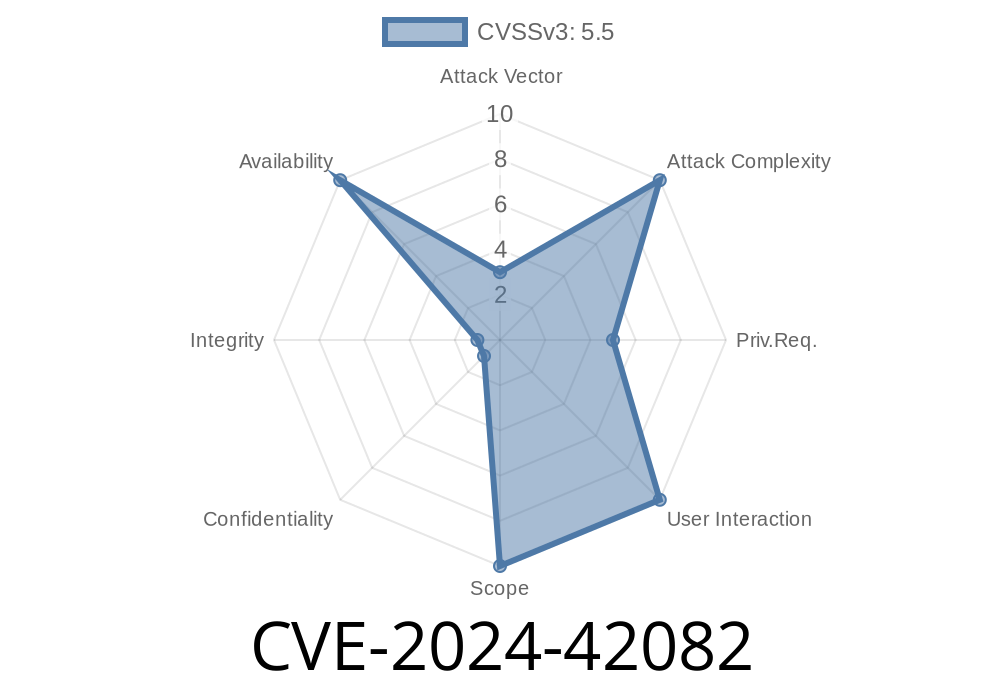
In 2024, a vulnerability tracked as CVE-2024-42082 was reported and quickly resolved in the Linux kernel’s eXpress Data Path (XDP) subsystem. This flaw was surfaced during stress testing by syzkaller, an open-source kernel fuzzing tool, and involved improper error handling in memory model registration, leading to unnecessary warnings that could confuse kernel debugging and stability efforts.
This post will explain what happened, why it matters (even though there was no direct exploit), how the patch works, and what developers should learn from this case.
The Problem: A Spurious Kernel Warning
The core of the issue was in the __xdp_reg_mem_model() function in net/core/xdp.c (Linux kernel networking code).
During fuzzing, syzkaller forced an allocation failure in the XDP memory model registration path.
- This caused the code to hit a WARN statement — essentially making the kernel log a warning (stack trace), suggesting a possible ugly bug.
Stack Trace Example
WARNING: CPU:  PID: 5065 at net/core/xdp.c:299 __xdp_reg_mem_model+x2d9/x650 net/core/xdp.c:299

CPU:  PID: 5065 Comm: syz-executor883 Not tainted 6.8.-syzkaller-05271-gf99c5f563c17 #
Hardware name: Google Google Compute Engine/Google Compute Engine, BIOS Google 03/27/2024
RIP: 001:__xdp_reg_mem_model+x2d9/x650 net/core/xdp.c:299
...
Two error possibilities in the __mem_id_init_hash_table() helper
1. Memory allocation failure (likely induced by fault injection/fuzzing).
Code Snippet (before patch)
int __xdp_reg_mem_model(void)
{
    int err;

    err = __mem_id_init_hash_table();
    if (err) {
        WARN(1, "Failed to initialize mem_id hash table");
        return err;
    }
    // ... rest of function
}
The reality: Only memory allocation failures can trigger this error, which are a normal operational concern—not a kernel logic flaw. Using WARN() was overkill and pollutes logs with unnecessary stack traces.
What changed?
The fix simply removes the WARN() call and lets the error bubble up as-is.
Code Snippet (after patch)
int __xdp_reg_mem_model(void)
{
    int err;

    err = __mem_id_init_hash_table();
    if (err)
        return err;

    // ... rest of function
}
Effect: If memory allocation fails (which may happen in extremely stressed or limited systems), the function now just returns an error code with no excessive logging.
Who fixed it?
Patch developed by the Linux networking maintainers after syzkaller’s report, with initial discovery by Linux Verification Center (linuxtesting.org).
Exploit Details: Is There a Security Impact?
Although CVE-2024-42082 is tracked with a CVE-ID, it was not exploitable in the traditional sense:
No kernel panic or crash in real-world setups.
The only "impact": The warning could confuse sysadmins and kernel developers, especially when looking for deeper bugs, or could potentially fill up logs if allocation fails under repeated stress (e.g., low memory attack, but not specific to XDP).
How Syzkaller Found It
syzkaller is well-known for surfacing rare kernel edge cases by fuzzing system calls and injecting artificial faults, such as memory allocation failure.
Reference: syzkaller's GitHub
By simulating failures that are hard to trigger, it ensures even “impossible” or rare error-handling paths are safe and quiet.
Code for Minimal Reproduction
Here is a very simplified demonstration to show the principle. It’s just C, not kernel code, but mimics the flow:
#include <stdio.h>
#include <stdlib.h>

int init_table() {
    if (rand() % 5 == ) // simulate rare failure
        return -1;
    return ;
}

int reg_model() {
    int err = init_table();
    if (err) {
        // Old code:
        // fprintf(stderr, "WARN: Failed to initialize!\n");
        return err;
    }
    printf("Table initialized.\n");
    return ;
}

int main() {
    if (reg_model())
        printf("Error!\n");
    else
        printf("Success.\n");
    return ;
}
This demo shows how returning errors without spammy logs is often correct.
Original References
- Linus Torvalds' Linux Kernel Source
- Patch: net: xdp: Remove WARN() from __xdp_reg_mem_model()
- syzkaller kernel fuzzer
- Linux Verification Center (linuxtesting.org)
Lessons Learned
1. Be careful with excessive warnings: Reserve WARN()s for real, impossible codepaths. Don’t warn on normal operational errors like allocation failure.
2. Fuzzing tools matter: Automated testing tools like syzkaller catch rare edge cases most humans never will.
3. Small bugs can confuse: Even harmless warning logs can mislead kernel developers or sysadmins, especially at scale.
Conclusion
CVE-2024-42082 is a textbook example of why robust, quiet error handling is critical in kernel-space code. Automated tools like syzkaller help make even rare error paths safer, and proper cleanup by maintainers ensures a smoother experience for everyone running the Linux kernel.
If you maintain kernel code: Don’t warn on normal errors, and keep your error paths simple!
For more detail, see the original Linux kernel patch:
Remove WARN() from __xdp_reg_mem_model()
Read about syzkaller’s finds:
syzkaller GitHub
*Found by Linux Verification Center (linuxtesting.org) using syzkaller.*
Timeline
Published on: 07/29/2024 16:15:07 UTC
Last modified on: 07/30/2024 19:04:15 UTC