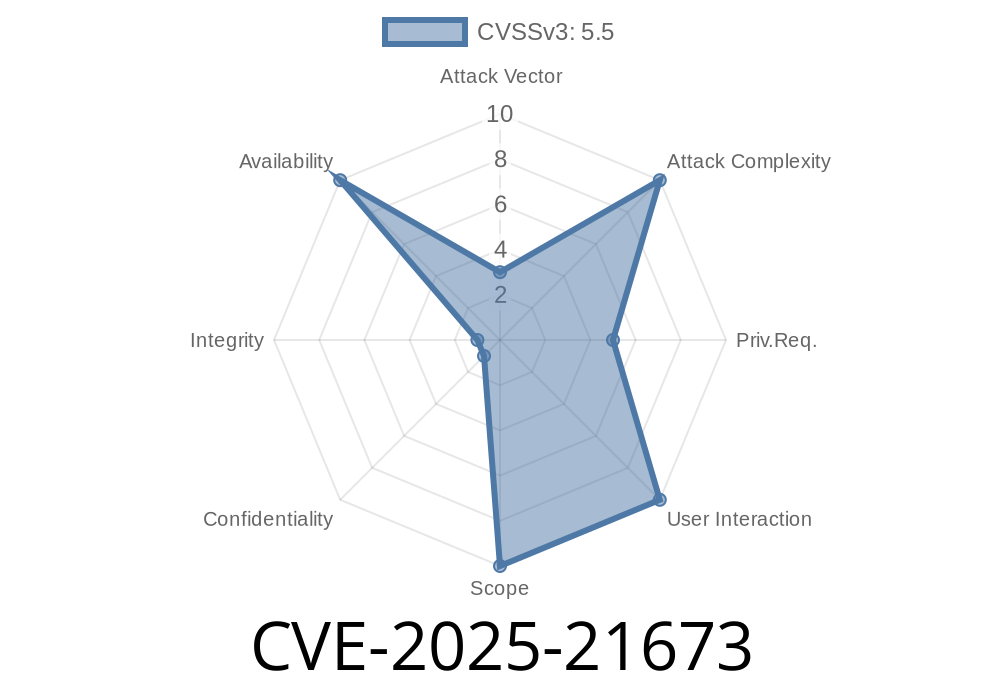
A newly resolved vulnerability, CVE-2025-21673, affected the Linux kernel’s SMB (Samba) client implementation, in particular the handling of hostnames within the Common Internet File System (CIFS) module. The issue was a double free condition in the TCP_Server_Info::hostname field, which could result in kernel crashes and potentially exploitable security flaws.
In this exclusive deep dive, we’ll break down how this bug occurs, the technical impact, a simplified view of the patch, and links to further reading.
The Vulnerability at a Glance
The core of this flaw was in the shutdown sequence of a CIFS TCP server session. During the shutdown (cifs_put_tcp_session()), a kernel thread responsible for handling connections (cifsd) might still be reconnecting to various Distributed File System (DFS) targets. The problem arose if the hostname field was freed while these reconnections were in progress—resulting in a classic double free scenario.
That could lead to random kernel memory corruption, crashes, or, in worst-case scenarios, privilege escalation via crafted exploitation.
Where It Happened
The bug was traced to the mainline Linux kernel CIFS client code (around the function cifs_put_tcp_session). Multiple threads or re-entries into cleanup code could accidentally free the same hostname pointer twice.
Here’s what a crash looked like if triggered
RIP: 001:__slab_free+x223/x3c
Code: ... <f> b 41 f7 45 08 00 d 21 00 f 85 2d ff ff ff e9 1f ff ...
...
Call Trace:
 ? __reconnect_target_unlocked+x3e/x160 [cifs]
 ? extract_hostname+x5c/xa [cifs]
 ? __slab_free+x223/x3c
...
Understanding The Double Free
A double free means a piece of memory is *freed* (returned to the system) more than once. This usually happens when a pointer to memory (e.g. char *hostname) is released, but some part of the code still tries to use it or release it again.
TCP_Server_Info::hostname is a dynamically allocated string.
- The cleanup code and the DFS reconnection code did not properly coordinate ownership and lifecycle for this pointer.
- Possible scenario: main shutdown thread frees hostname, while the reconnecting thread (kthread) also tries to clean it up after detecting a shutdown, hitting a use-after-free or double-free in the kernel’s memory allocator.
Here’s a simplified view of what went wrong
void cifs_put_tcp_session(struct TCP_Server_Info *server) {
    if (server->hostname)
        kfree(server->hostname);
    // ...
    // Elsewhere, in reconnection:
    if (server->hostname)
        kfree(server->hostname); // <-- could be already freed!
}
The Patch
The fix makes sure hostname is not freed until the last thread is done, typically by moving the kfree() out of the vulnerable code paths and waiting for all reconnections to finish before cleaning up.
Patch Example (Simplified)
- if (server->hostname)
-     kfree(server->hostname);
+ // Let cifsd thread finish any possible reconnections first
(For full technical details, see the commit
> Linux kernel git commit
This ensures there are no concurrent frees of the hostname field, eliminating the vulnerability.
Exploitability and Security Impact
- Crash/Denial of Service: The most likely outcome is a kernel crash (panic) if memory is double-freed.
- Privilege Escalation: If an attacker can trigger DFS reconnections and session shutdowns in a crafted way, *theoretically* arbitrary code execution in kernel mode is possible (though highly non-trivial).
- Default Exposure: Only systems using CIFS/Samba mounts and DFS (Distributed File System) targets are at risk.
Exploitation Steps (Pseudo-Exploit)
_For research purposes only. Modern distributions should be patched and exploitation in real-world is extremely difficult._
// userland code, as an outline:
mount -t cifs //multiple DFS targets
// Signal disconnect (kill cifsd?)
// Rapidly reconnect to targets in a way that races the shutdown
// Hope to trigger double free during shutdown and reconnection overlap
// If successful, observe kernel crash or memory corruption
Upgrade your Kernel: Distributions have released patched kernels. Always update.
- Watch for Samba/CIFS Updates: If you manage Samba servers, consider generic mitigations (such as strict session closure and monitoring).
- Kernel Hardening: Enable additional kernel hardening (e.g., SLUB freelist randomization).
Upstream Commit:
- smb: client: fix double free of TCP_Server_Info::hostname
Security Advisory:
- CVE-2025-21673 entry on cve.org
Linux Kernel Mailing List:
Conclusion
CVE-2025-21673 is a significant reminder of the dangers of double-free bugs in kernel space, especially with multiple threads and complex protocols like CIFS/DFS. While most users just need to update, kernel developers and security professionals should study and understand this class of vulnerability — and make sure code guards memory ownership boundaries tightly.
---
Stay updated, stay secure!
Feel free to share or cite this exclusive breakdown.
Timeline
Published on: 01/31/2025 12:15:28 UTC
Last modified on: 02/04/2025 15:33:41 UTC